
By Salman Lali
One of the most persistent myths in global security thinking is that credibility can be manufactured. In reality, it is earned — usually under fire. Over the past year, Pakistan has done precisely that, emerging not through rhetoric or alliance branding, but through demonstrated battlefield performance and timely strategic positioning.
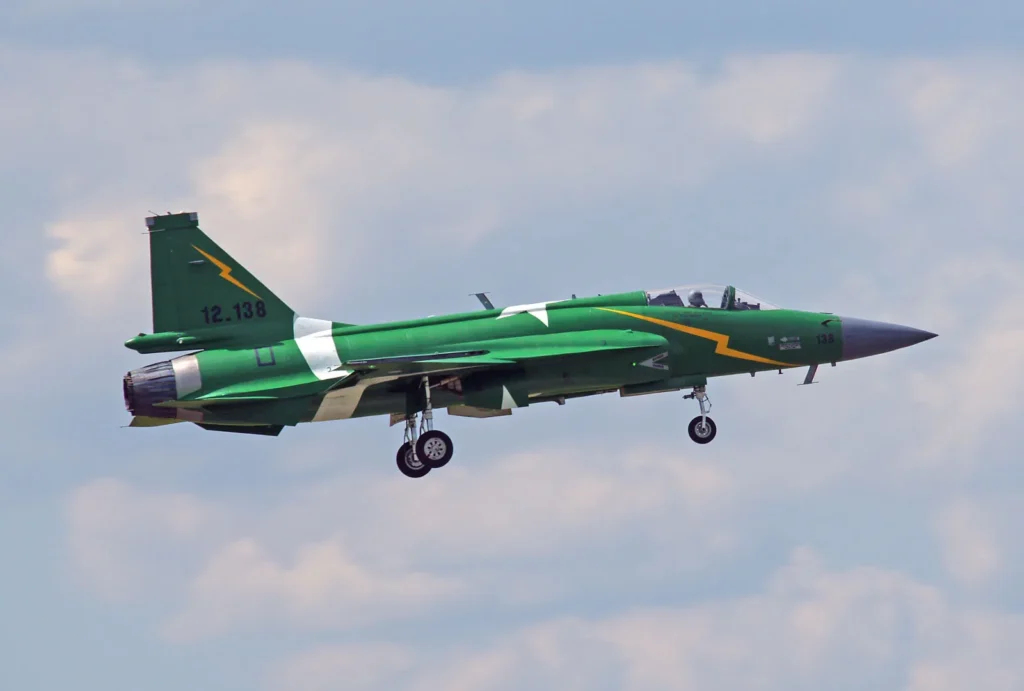
Last year’s brief but consequential military confrontation between India and Pakistan in May 2025 marked a turning point that is still being underestimated. Within a matter of hours, Pakistan deployed a mix of indigenous and jointly developed platforms — most notably the JF-17 Thunder and J-10C fighters — to blunt and reverse Indian air operations. The clash ended quickly, not because tensions evaporated, but because escalation suddenly looked costlier than anticipated.
While official narratives diverged in New Delhi and Islamabad, external observers were more candid. A January 2026 Reuters assessment noted that Pakistan’s “use of domestically produced, combat-tested aircraft under live conditions significantly boosted international confidence in its defence manufacturing base” .
That phrase — combat-tested — matters more today than at any point since the Cold War.
From Regional Clash to Global Signal
The Ukraine war has drained Western arms stockpiles. Sanctions have constrained Russian exports. Advanced systems now come with political conditions, delivery delays, and prohibitive costs. Against this backdrop, Pakistan’s defence offerings sit in a rare category: affordable, available, and proven.
The JF-17 Thunder, priced between $30 million and $40 million, is now being actively evaluated by more than a dozen countries across Africa, the Middle East, and Southeast Asia. Reuters reports that negotiations with six to eight states are already at advanced stages, a surge driven largely by the aircraft’s performance in the 2025 India-Pakistan clash .
This is not ideological alignment. It is procurement logic.
As one Gulf defence official told Reuters anonymously, “In today’s environment, we care less about brochures and more about whether a system has survived a real fight” .
The Doha Shock and the Saudi Wake-Up Call
If Pakistan’s battlefield credibility created interest, events in the Gulf created urgency.
In September 2025, Israel carried out an airstrike in Doha, targeting Hamas figures reportedly present during indirect ceasefire discussions. The strike killed six people, including Qatari nationals, and sent a jolt through the Gulf security establishment. Qatar was not at war. It was hosting talks. Yet it was struck.
The incident, widely reported and condemned, shattered a long-held Gulf assumption: that hosting diplomacy or maintaining neutrality insulated capitals from kinetic spillover. AP News described the strike as triggering “deep unease across Gulf monarchies about the reliability of existing security arrangements” .
Saudi Arabia took that lesson seriously.
Within days, Riyadh invited Pakistan’s prime minister for high-level talks. On September 17, 2025, the two countries signed a Strategic Mutual Defence Agreement, declaring that an attack on one would be treated as an attack on the other.
This was unprecedented.
As AP News noted at the time, the pact represented “a significant shift away from Saudi Arabia’s exclusive dependence on U.S. security guarantees” .
Saudi officials were careful in public. Privately, the logic was blunt: deterrence must be credible, immediate, and unconstrained by foreign legislatures.
Why Pakistan — Not Symbolism, But Capability
Pakistan brought three things Saudi Arabia needed:
- A nuclear-armed military with disciplined command and control
- Conventional forces recently tested against a peer adversary
- Political readiness to commit without procedural paralysis
Pakistan had long stationed troops in Saudi Arabia for defensive purposes, guarding sensitive sites and training forces. But this pact went further. It codified obligations rather than understandings.
Pakistan’s Defence Production Minister Raza Hayat Harraj later confirmed that the agreement was already operational and that any expansion to include additional partners would be “welcomed” .
Turkey’s Calculated Interest
Turkey’s interest followed naturally.
By early 2026, Ankara confirmed it was in advanced discussions to join or align with the Saudi-Pakistan defence framework. Turkish Foreign Minister Hakan Fidan publicly acknowledged the talks, stating that “consultations are ongoing, though no final agreement has yet been signed” .
For Turkey, the appeal is practical. Access to Gulf capital, Pakistani operational experience, and a non-Western security architecture offers strategic hedging at a time when relations with Europe and the U.S. remain strained.
Together, the three states form a triangle of complementary strengths: Saudi financing, Turkish defence manufacturing, and Pakistani military credibility.
Economics, Not Just Strategy
For Pakistan, the implications are not merely geopolitical. They are economic.
Defence exports offer one of the few scalable, high-value avenues for foreign exchange growth. Reuters projects Pakistan’s defence exports could reach multi-billion-dollar levels by the end of the decade if current deals mature .
Production lines for fighter aircraft, drones, trainers, and air defence systems are expanding. Unlike aid or loans, these revenues come without conditionality.
In international politics, suppliers gain leverage. Clients hesitate before sanctioning or alienating those who underpin their security.
A Shift Worth Taking Seriously
Pakistan’s rise as a security provider is not about ideology or bloc politics. It is about timing, capability, and credibility earned under pressure.
In a fractured world where guarantees are questioned and wars return, Pakistan has positioned itself not as a claimant, but as a contributor.
That alone marks a strategic shift others would be wise not to dismiss.