
Islamabad says “Fitna al-Khawarij” and ISKP elements operating from across the border were behind recent suicide bombings as Kabul condemns the strikes and reports civilian casualties.
Pakistan carried out a series of airstrikes early Sunday inside Afghanistan, targeting what it described as militant camps and operational hideouts used by the banned Tehrik‑e‑Taliban Pakistan (TTP) and elements linked to the Islamic State Khorasan Province, in a rare and sharp escalation of cross-border military action.
The strikes, which Pakistani officials described as “intelligence-based, selective operations,” were presented by Islamabad as a direct response to a recent wave of suicide bombings and militant attacks inside Pakistan, including a bombing at a Shia imam bargah in Islamabad and separate attacks in the northwestern districts of Bajaur and Bannu during the holy month of Ramadan.
In an official statement, the Ministry of Information and Broadcasting said Pakistan’s armed forces had struck seven terrorist camps and hideouts belonging to what it described as “Fitna al-Khawarij” — the term increasingly used by Pakistani authorities for the TTP — as well as affiliated networks and fighters associated with ISKP, also known locally as Daesh.
Officials said Pakistan possessed “conclusive evidence” that the recent attacks were planned and directed from Afghan territory, with operational leadership and handlers based across the border.
“These groups have been repeatedly using Afghan soil to organise, train and launch attacks inside Pakistan,” the ministry said, describing the strikes as limited in scope and focused solely on militant infrastructure.
According to Pakistani officials, the targets were located primarily in eastern Afghan provinces, including Nangarhar Province and Paktika Province, with strikes reported in areas such as Behsud district, Girdi Kas village and the Barmal area near the frontier.
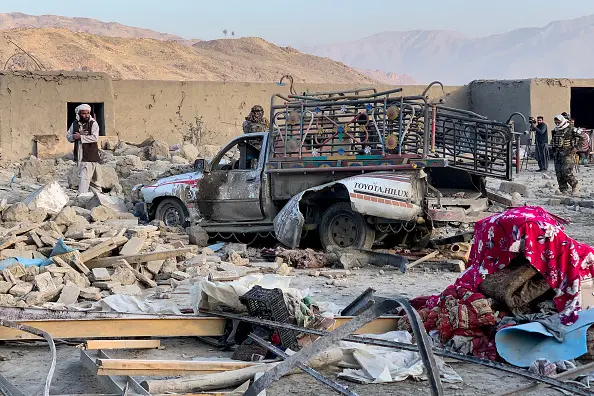
Local Afghan officials and residents reported explosions overnight and into the early hours of Sunday. Afghan media said several locations were hit in quick succession.
The Taliban-led government in Kabul strongly condemned the strikes. Zabihullah Mujahid, a spokesman for the administration, claimed without evidence that the attacks amounted to a violation of Afghanistan’s sovereignty and international law and claimed that civilian areas — including homes and a religious seminary — had been struck.
As per unverified claims of Afghan officials, dozens of civilians were killed or wounded, including women and children. At least 17 people were reported killed in Nangarhar alone, according to provincial authorities, while other local and humanitarian sources cited higher figures, warning that some victims remained trapped under rubble.
Mujahid said the Afghan authorities would not allow the incident to go unanswered and promised a “calculated and appropriate response” at a suitable time, adding that the strikes during Ramadan violated Islamic values.
Islamabad, however, defended the action as an act of self-defence and stressed that it had exhausted diplomatic channels over the past two years to press Kabul to act against what it describes as TTP safe havens.
Pakistan’s security establishment has repeatedly argued that the resurgence of TTP violence since 2021 is directly linked to the group’s ability to operate with relative freedom across the border. In official statements, the group is increasingly portrayed as part of a wider extremist constellation that Pakistani officials describe as both “Fitna al-Khawarij” and, in domestic political discourse, elements of “Fitna-e-Hindustan” — a term used to underline what Islamabad sees as externally exploited (by India) militant threats to Pakistan’s internal security.
The latest strikes again highlight the unresolved and deeply sensitive nature of the frontier between the two countries on the border that has long been a flashpoint for clashes, fencing disputes and militant movement.
For Pakistan, the issue has increasingly become framed not only as a border management problem but as a national security emergency. Officials say recent suicide bombings have targeted both civilians and security personnel and have been timed to maximise social and sectarian impact.
Pakistan’s military did not disclose which aircraft or platforms were used in Sunday’s operation, although similar past cross-border actions have involved fighter jets and precision-guided munitions. Officials emphasised that the strikes were carefully planned to avoid civilian harm and were confined to what they described as confirmed militant facilities.
Independent verification of both the nature of the targets and the casualty figures has not been possible. Access to the remote and mountainous border regions remains extremely limited, and international monitoring missions do not have a permanent presence in the affected districts.
The incident risks further straining already fragile relations between Islamabad and Kabul. Pakistan has repeatedly accused the Taliban authorities of failing to act against the TTP despite public assurances, while Afghan officials deny providing sanctuary to the group and instead accuse Pakistan of externalising its own internal security failures.
Regional analysts say the episode reflects a growing shift in Pakistan’s counter-terrorism posture, away from diplomatic pressure alone and toward limited, overt cross-border action when attacks inside Pakistan are traced back to what Islamabad considers verified external command nodes.
For now, there were no reports on Sunday afternoon of immediate Afghan military retaliation. But the sharp exchange of statements from both sides has reinforced concerns among diplomats and regional security officials that further incidents along the frontier could quickly escalate — particularly as militant violence inside Pakistan continues and pressure mounts on the government to demonstrate that it can disrupt what it sees as Afghan-based command and support networks behind the latest attacks.