
By Salman Lali.
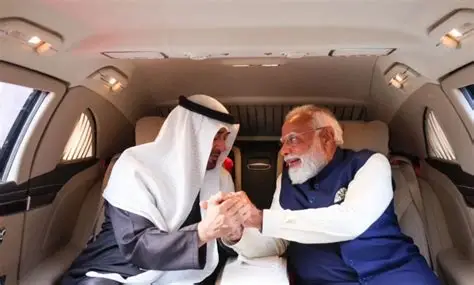
When the United Arab Emirates and India announced a defence partnership in January 2026, the agreement was quickly framed as a “natural extension” of their growing economic and political ties. Official statements spoke of interoperability, joint training, and shared regional interests. The optics were polished. The substance, however, deserves closer scrutiny.
Stripped of diplomatic language, the UAE–India defence pact is not the product of long-term strategic convergence. It is better understood as a reactive arrangement, shaped by regional shocks, deepening Gulf rivalries, and Abu Dhabi’s growing sense of strategic vulnerability. Far from stabilising the region, the pact risks adding another brittle layer to an already fragmented security architecture.
A pact born of regional shock
Timing matters in geopolitics, and the timing of this agreement is revealing.
The UAE–India pact came barely four months after Saudi Arabia and Pakistan signed their Strategic Mutual Defence Agreement in September 2025 — a treaty that, for the first time, committed both states to treating an attack on one as an attack on the other. That agreement, unlike the UAE–India deal, was explicit, binding, and rooted in decades of defence cooperation.
The regional context was already volatile. In late 2025, tensions between Saudi Arabia and the UAE spilled into the open over Yemen. Riyadh publicly accused Abu Dhabi of backing Southern Transitional Council (STC) forces advancing dangerously close to Saudi borders in Hadramawt and Mahra. Saudi air strikes on STC-linked positions followed, alongside reports of a partial Emirati military pullback.
This was not a minor disagreement. It marked the most serious rupture in Saudi–UAE relations since the Yemen war began.
Rather than recalibrating its relationship with Riyadh — the Gulf’s central military and economic power — Abu Dhabi opted for an external hedge. India, distant but symbolically powerful, emerged as a convenient counterweight. The result was a defence pact that looks less like strategic planning and more like damage control.
An alliance with built-in contradictions
At the heart of the UAE–India partnership lies a set of contradictions that are difficult to ignore.
First, there is no mutual defence clause. Unlike the Saudi–Pakistan agreement, India has not committed itself to defending the UAE in the event of an attack. The pact focuses on training, logistics, aircraft maintenance (notably Rafales), and potential missile or naval cooperation. In practical terms, this makes the arrangement asymmetric: the UAE gains symbolism and limited capability support; India gains access, visibility, and influence — without binding obligations.
Second, the power imbalance is stark. The UAE has a total citizen population of roughly 1.1 to 1.5 million. Its armed forces, though well-equipped, rely heavily on expatriates, contractors, and foreign expertise. India, by contrast, is a nuclear-armed state of 1.4 billion people with one of the world’s largest standing armies.
This is not a partnership of equals. It is a relationship in which strategic dependence could deepen rapidly — particularly for the UAE.
Third, there is a doctrinal mismatch. India’s military doctrine is shaped primarily by the need to deter and, if necessary, fight large-scale conventional wars against China and Pakistan. The UAE’s security concerns are of an entirely different nature: Iranian missile and drone threats, proxy warfare, maritime security in the Strait of Hormuz, and internal stability.
There is limited overlap between these threat perceptions. Interoperability, beyond symbolic exercises, will be difficult to sustain.
Saudi leverage
Any assessment of this pact must also account for India’s broader regional dependencies — particularly its relationship with Saudi Arabia.
Saudi Arabia remains one of India’s top crude oil suppliers. More than 2.5 million Indian citizens live and work in the Kingdom, sending billions of dollars home in remittances. Riyadh also holds quiet but significant leverage through pilgrimage diplomacy, labour policy, and energy pricing.
New Delhi is acutely aware of these realities. It is therefore implausible that India would jeopardise its relationship with Saudi Arabia for the sake of a non-binding defence arrangement with the UAE.
This reality exposes the pact’s limits. In any serious regional crisis involving Saudi Arabia, India’s room for manoeuvre would be narrow. The UAE, in turn, cannot rely on India for hard security guarantees when it matters most.
The UAE’s structural vulnerability
For all its wealth and technological ambition, the UAE remains structurally fragile.
Its small citizen population limits mobilisation capacity. Its reliance on foreign labour and contractors introduces long-term risks. And its increasingly interventionist foreign policy — from Yemen to Libya to the Horn of Africa — has created more security liabilities than assets.
By tying itself more closely to external powers such as India and Israel, Abu Dhabi risks strategic subordination. Defence cooperation can quietly evolve into dependence, particularly when one partner controls advanced systems, intelligence flows, and operational know-how.
History offers cautionary examples. States that outsource security too extensively often find their foreign policy autonomy eroded over time.
Emergence of blocs in GCC
The broader regional consequence of this pact is the acceleration of bloc politics.
On one side, a loose alignment appears to be forming around Saudi Arabia and Pakistan, with potential links to Turkey and other Muslim-majority states pursuing strategic autonomy. On the other, the UAE’s growing alignment with India and Israel signals a different security orientation.
Such polarisation raises the risk of proxy competition — particularly in fragile theatres such as Yemen, the Red Sea, and the Horn of Africa. For smaller states and non-state actors, this creates incentives to hedge, arm, and escalate.
None of this enhances regional stability.
Turning Against Its Own Foundations?
Beyond contractual ambiguities and power imbalances, the deeper question is this: Why is the UAE pursuing partnerships that seem to contradict its geographic reality and historical position within the Muslim world? The answer, increasingly, lies in a particular worldview cultivated at the highest levels of Emirati leadership — one that places control and external alignment over regional cohesion and internal legitimacy.
This worldview has manifested in multiple, public ways that deserve scrutiny.
Influence Campaigns Against Muslim Activism Abroad
Perhaps the most striking example is the UAE’s involvement in financing influence operations targeting Muslim activists, organisations, and civil society actors across Europe.
In 2023, investigative reporting based on leaked documents revealed that the UAE funded a Swiss private intelligence firm to compile dossiers on Muslim activists, charities, and politicians in multiple European countries — branding them as extremists or linked to organisations like the Muslim Brotherhood. These campaigns went far beyond targeting specific militant groups; they cast a wide net that swept up mainstream Islamic organisations and civic actors alike.
The scale was eye-opening:
- The leaked material documented efforts to influence public perception of Muslim organisations across 18 European countries, including Germany, France, the Netherlands, and Belgium.
- Individuals with long records of peaceful activism were labelled in internal documents as threats to European security.
- The sophistication and reach of the campaign suggested state-level sponsorship rather than isolated consultancy.
These revelations — widely reported by openDemocracy and examined in European parliamentary inquiries — were not dismissed as fringe gossip. Governments formally protested, journalists documented the tactics, and civil liberties groups expressed alarm at the attempt to reshape public discourse on Muslim identity and civic engagement.
The significance of this episode is not merely anecdotal. It reflects a strategic posture in which Islamic activism is treated as a universal security risk, regardless of context or legitimacy. It also raises the question of whether the Gulf’s pivot away from Muslim-majority solidarity is ideological, political, or rooted in a deeper strategic insecurity.
(For detailed reporting, see: “Abu Dhabi Secrets” investigation on openDemocracy: https://www.opendemocracy.net/en/abu-dhabi-secrets/)
Yemen: The Most Visible Rift with Saudi Arabia
Another defining episode is the UAE–Saudi rupture in Yemen.
Since 2015, Saudi Arabia and the UAE were nominal allies in the Yemen conflict. Riyadh bore the bulk of the political and military cost, focused on restoring a recognised government and countering Houthi destabilisation near its border. The UAE — motivated by a different strategic calculus — invested in proxy forces, notably the Southern Transitional Council (STC), which aligned with Abu Dhabi’s long-term interest in a separate political dispensation in southern Yemen.
By late 2025, tensions boiled over in public view. Saudi authorities formally accused the UAE of directing elements of the STC toward Saudi border areas in Hadramawt and Al Mahra — moves that Saudi leaders interpreted as provocative and destabilising, not cooperative. Riyadh responded with military strikes against STC positions supported by Abu Dhabi, a rare and serious rift between two monarchies that had, until then, presented a united front.
For outside observers, this episode was surprising because it challenged the long-standing assumption that Gulf monarchies operate in lockstep. But for Saudi strategists, it confirmed something long suspected: that Abu Dhabi views security through a parametric lens — one driven by tactical influence rather than strategic alignment.
In other words, where Riyadh prioritises an orderly balance of power and cohesive Arab diplomacy, Abu Dhabi has increasingly placed transactional relationships and unilateral influence operations above collective outcomes.
Small State, Big Risks: The Limits of External Alignment
This brings us to a fundamental vulnerability — one that does not afflict major powers but is critical for a small, demographic-limited state like the UAE.
National power is not only about wealth or weapons; it is about demography, social cohesion, and land mass. The UAE’s indigenous citizen population is small and reliant on foreign labour. Its security apparatus leans heavily on expatriate expertise and foreign contractors. Its domestic legitimacy does not rest on deep popular mobilisation but on economic performance and stability.
In such a context, aligning too closely with foreign powers that lack organic stakes in the Gulf can be hazardous. If, hypothetically, sentiment across the Muslim world shifted sharply — if investors from Muslim-majority countries reconsidered where they invest — there is no ready demographic or economic substitute for those ties. External alignments with powers like India or Israel do not intrinsically create that substitute; they may, in fact, strain existing networks.