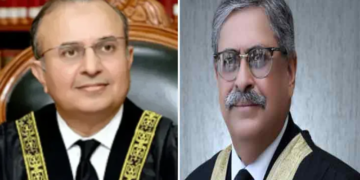


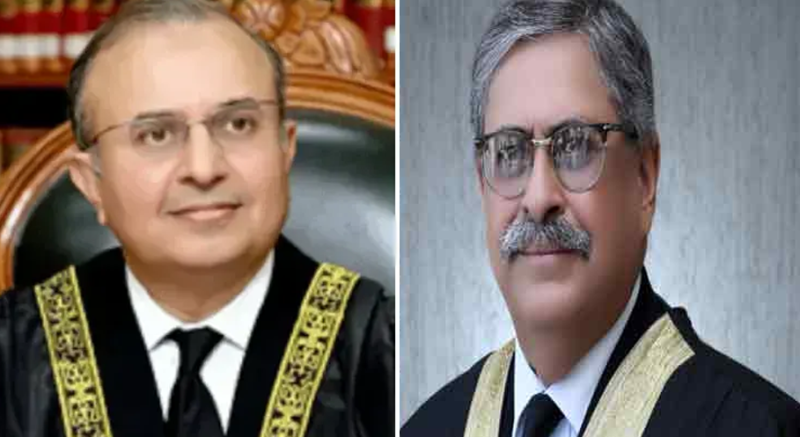
The resignations of Justice Mansoor Ali Shah and Justice Athar Minallah have landed like a cold hush over the country — the kind of silence that comes when two lamps are suddenly snuffed out in a room already dimly lit. In a judiciary often marred by internal divides, whispered pressures, and political crosswinds, both men stood out for something painfully rare in our public life: a sense of inner discipline, and the courage to say “no” when it mattered most.
Justice Mansoor Ali Shah built his reputation long before the public learned to pronounce the legal jargon he championed. As Chief Justice of the Lahore High Court, he pushed for modernisation at a pace our system wasn’t used to. Filing counters were digitised, case calendars appeared online, and alternative dispute resolution — a concept once treated as an exotic import — slowly found a foothold. He carried a quiet, methodical mind, the kind that believed that justice should not only be done, but also seen, understood, and accessed.
Justice Athar Minallah entered the national conversation with a different kind of energy — morally restless, often speaking truths that made the powerful uncomfortable. His years on the Islamabad High Court produced judgments that gave voice to the voiceless: missing persons, ordinary citizens crushed under administrative highhandedness, and those trapped in the gaps of a system designed for the privileged. His judicial philosophy was simple: the Constitution is not a piece of furniture; it is a living promise that must not be betrayed.
Both men carried distinct temperaments, yet they converged on one essential principle: a judge must stand where the Constitution stands, even if the ground beneath that principle is shaking.
That is precisely why their resignations sting. They did not step down because of personal grievances or professional ceilings. They stepped down because they believed the passage of the 27th Constitutional Amendment had taken a knife to the very heart of the judicial structure — shifting authority, diluting the Supreme Court, and placing constitutional adjudication at the mercy of political engineering. For them, remaining on the bench under a compromised structure was not service. It was complicity.
The Slow Crumbling of an Institution
Pakistan’s judiciary has always existed on a faultline. From the Doctrine of Necessity to the selective activism of different eras, the courts have swayed between courage and capitulation. There have been moments of spine — the lawyers’ movement, the brief era of restoration, and scattered judgments that hinted at a bolder future. But there have also been seasons when the bench bent before force, offering legal cover to everything from coups to controversial ordinances.
We may pretend otherwise, but our jurisprudence carries scars of political obedience.
That is why independent judges matter. They serve as the institutional conscience — people who remind the state that law is not a plaything, and power is not a blank cheque. When such voices walk away, they do not merely leave behind empty chairs; they leave behind a void in the country’s moral imagination.
What Happens When the Judiciary Loses Its Will
A country without an independent judiciary does not collapse overnight. It decays — quietly, steadily, and often without drama.
The first thing to erode is trust. Litigants stop expecting fairness; lawyers begin to work the “right channels” instead of making the right arguments; powerful institutions learn they can bend outcomes without consequence.
The second is rights. When the courts cannot check executive excess, fundamental freedoms become ornamental. Habeas petitions linger. Administrative abuse passes unchecked. The vulnerable lose their last line of defence.
The third is democratic balance. A judiciary that cannot challenge unlawful authority paves the way for authoritarian governance — whether elected or unelected. Constitutionalism becomes a ceremony, not a reality.
In short: when the judiciary loses its independence, the Republic loses its spine.
Why These Resignations Should Disturb Us
The departures of Shah and Minallah are not signs of a routine reshuffle. They represent something deeper — the feeling that the judiciary is entering a new and more compromised era, where structural changes can be made without meaningful resistance, and where dissenting judges feel they are shouting into a void.
These resignations leave us with a troubling question:
If even the most principled judges no longer see space for constitutional justice, how much space remains for the ordinary citizen?
That is the heartbreak at the centre of this moment.
In losing Justice Mansoor Ali Shah and Justice Athar Minallah, we have lost two reminders of what the judiciary could have been — modern, moral, and constitutionally anchored.
Their absence will echo. The silence they leave behind will not be easily filled.
And unless this country confronts why they felt compelled to leave, the judiciary’s crisis will not remain confined to courtrooms; it will seep into the bones of our democracy.